The Prime of Miss Jean Brodie

Page turner: 7/10
Heart tugger: 8/10
Thought provoker: 7/10
Overall: 4 stars

The Prime of Miss Jean Brodie is charming. It is witty, well constructed, emotionally mature, and just … Delightful.

I say all of these things in a way that I hope doesn’t make it seem too ‘girly’ or trivial. Because, although the book isn’t about a great epoch of history, or moment of huge political significance it still holds its own with regards to depth and strength.

The book is about a Miss Jean Brodie – primary school teacher, art-appreciator, lover, influencer, and overall woman in her prime of life – and her relationship with those around her. Her ‘set’ of six girls who are under her spell (to varying degrees) are all profoundly affected by her, even in ways they themselves (I think) don’t quite appreciate even as adults looking back. It is mostly set in the 1930s (Miss Brodie is quite a fan of Mussolini – he is so organized!) and there is something of an Art Deco feel to the whole book. I am not sure if describing a work of literature as ‘Art Deco’ is some form of metaphor-synesthesia … But it works. Either that or I have been unduly influenced by the cover art of the book, which I think is beautiful.
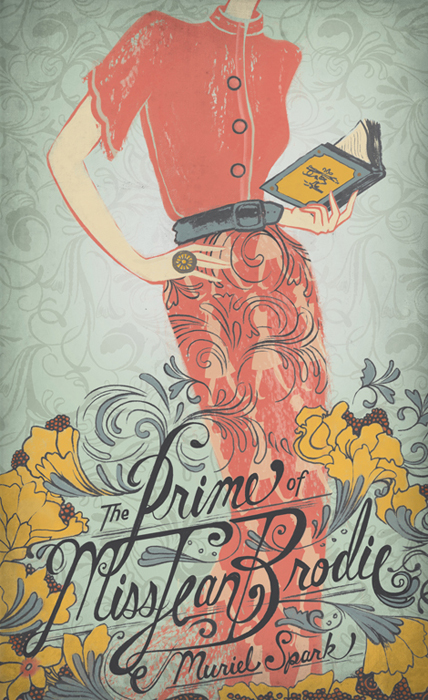
The Prime of Miss Jean Brodie book cover

Brodie herself is somewhat irresistible if not necessarily loveable, and her girls are outlandish on the surface but still somehow very real. You can’t help but to feel part of them all.

It is perhaps obvious to say that the author, Muriel Spark, is a woman, and sadly not that many female authors feature on the various award-winning book lists.  I count 7 on the Modern Library’s top 100. In this case this book also centres on the lives and livelihoods of women and what they would and should become. Brodie is a  mix of ‘modern’ and ‘traditional’ but Spark knows what she is on about and foibles and prejudices are subtly noted.  Miss Brodie is definitely not what I expected her to be in the opening pages, as as she and the book both develop it is clear how masterful, calculated, and clever Spark is. The author shies from nothing – heck, one of the girls is ‘known for sex’ – and misses even less. And in my head (again, this could be the delightful cover art) she writes with an almost-smile a la Mona Lisa, who is also mentioned in the novel.

Clocking in at a very slim 128 pages, The Prime of Miss Jean Brodie is well judged, well edited, and … well enjoyable. Besides, it is only 128 pages means even if you don’t take my word for it you have very little to lose!

A Passage to India

Page-turner: 7/10
Heart-tugger: 7/10
Thought-provoker: 8/10
Overall: 4 stars

Reading A Passage to India has been a bit like watching the tide come in, on a dark summer night. There is an inevitable slowness to it that builds strongly and beautifully but never (can’t) break out of its own rhythms.  And at the end I feel quite washed away by it.

I am speaking in metaphors, but can’t quite stop myself as I only put the book down a few minutes ago. It is a beautiful and powerful book. Just not a ‘loud’ or ‘obvious’ one. The plot is very, very simple; the book is interesting purely because of its characters. They are developed to be thoroughly and completely human.  They are flawed, irrational, thoughtful and mean but compassionate and totally a product of their own cultures. Discourse – between Indians and Ango-Englishmen, Indians and Indians, or Englishmen with the Anglo-English – always contains subtext, emotion, and misunderstanding. It’s incredibly frustrating. But all the more ‘real’ for it. I Believe in the book.

First published  in 1924, A Passage to India is ranked 25th on the Modern Library’s top 100 books of the 20th Century. And, I agree it should be on that list (though don’t feel particularly entitled to put it in a ranked order). It takes place at about the time it was published in Imperial India. And the book is the story – a study – in how the ruling race and the indigenous one manage to cohabitate a continent in a way that neither fully understands. There is some talk of love, though it isn’t a love story, and politics though it is by no means a polemic. It’s just a story about people – prejudices – and how they clash.

The subtly with which Forster develops the main characters is stunning : aptly named Miss Quested whose own quest causes disaster for all around her, school master Mr Fielding, and ‘Oriental’ Dr Aziz. Forster’s Oriental imbues an Otherness that would likely irk a modern anthropologist, but I think it is more of a trope than a truism. He makes Aziz’s preference towards the emotional and dramatic to be a product of a different human culture, rather than innately irrational and primitive.

It is fair to say that not a huge amount Happens in the book, but that doesn’t really matter. And coming from someone who generally believes that a good book is just a very good story – that’s pretty impressive. Its beauty and slowness and repetition is engrossing. The heat is languid. You just can’t expect that much to happen when it is so hot. And even when it does, there is a distance to it that makes the book have something of a surreal quality. The chant of ‘Esmiss Esmoor’ is still echoing in my brain. I won’t spoil why that’s important, but I will say that the character it refers to clearly my hero of the book. The one who understands it all the best. And it is nice for an old woman to be ‘right’ and pseudo-heroic where others are silly and small and wrong.

Certainly read this book. It isn’t a Wow book, but it is a deep one. I am impressed by it. It also made an impression on me. I also (bizarrely) think reading this first might have made me a bit more compassionate towards some of the characters in Midnight’s Children – though at the same time reiterate to me how much more palatable a book is to me if it takes time to be crafted, controlled, and made human.

The Great Gatsby

Page turner: 7/10
Heart tugger: 8/10
Thought provoker: 8/10
Overall: 4 stars

I really, really liked The Great Gatsby.

Also: Liking it was a pleasant surprise.

I – like most other teenagers in America- read The Great Gatsby by F. Scott Fitzgerald in high school, and I remember feeling broadly ambivalent about it. But I think at the time I was looking for a happy ending, and my frustration and disappointment in the characters in the book meant my teenage self equated that with not liking the book. Whereas perhaps I should have realized that a book that could Make me feel disappointed might actually have something going for it. And actually, reading it now a decade and a half later (ish), I would quite happily read it again.

The thing is that this book is stunning. The language is descriptive, evocative, and meaningful without being overly descriptive. Which is particularly impressive given the opulence of the setting. After all, it takes place amid the extremely privileged crowds of New York and Long Island in 1922. Readers float along with the narrator, Nick Carraway, as he at first interprets his roaring life amongst the likes of the great Jay Gatsby as, potentially, the American Dream.

“There was music from my neighbor’s house through the summer nights. In his blue gardens men and girls came and went like moths among the whisperings and the champagne and the stars. At high tide in the afternoon I watched his guests diving from the tower of his raft, or taking the sun on the hot sand of his beach while his two motor-boats slit the waters of the Sound, drawing aquaplanes over cataracts of foam.”

I liken my experience of this book to that of my recollection of dreams: occasionally vivid but often overwhelming and blurry. And when I wake up I have an intense feeling of some emotion, without being quite sure how I got it. Yes, reading Gatsby is like having a dream, waking up, going back to sleep, and then having a bit of a nightmare.

I love Nick’s restraint, even as the dream-turns-nightmare. In the telling of events he states truth more often than his interpretation of it, so that when he does express his disapproval you feel it (and a warmness for him) all the more. But the way he paints a picture of the room as he enters it really what is outstanding – I don’t think I can now ever forget the white statuesque stances of Daisy and Miss Baker when he first visits them.

The Great Gatsby is a beautiful book. It is well worth overcoming your teenage impressions and giving it a re-read, and I can see why it is so high up the Modern Library’s list (though I am not-yet sure about being 2nd). I apologize to my 10th (11th?) grade English teacher. I am also horrified I can’t remember which year I read it. I might even open it again soon – at which point I reserve the right to give it 5 stars.

Olive Kitteridge

Page turner: 6/10
Heart tugger: 7/10
Thought provoker: 7/10
**Well crafted: 10/10**
Overall: 4 stars

**Making a special appearance for this book, is the ‘well crafted’ rating. When I originally decided on the different parts of the rating system I took the assumption that all of these books would be at least moderately well written and conceived. And a fifth means of rating a book seemed like a lot. But this book is so very much in a league of its own, I have temporarily introduced the metric so that everyone knows how much it excels. (The temporary rating is very clever colleague’s idea. Thank you.)**

Olive Kitteridge by Elizabeth Strout won the Pulitzer Prize for fiction in 2009. It really is the ‘American’ type of book that the Pulitzer Prize is looking for. Set in a small town on the coast of Maine in the years post 9/11, it resonates with all that is small-town Americana. But I think (hope) it would make it all the more appealing for an international audience as well.

Olive Kitteridge is the title and the central character of this story of the quietly intertwining lives of a town’s inhabitants. She is irritable, brooding, loving, passionate, and silent. She is the lynch pin of the book, tying together the narration as each chapter shifts to focus on the stories of other people’s lives. The execution is flawless. The story is tight – characters are never forgotten, or left hanging, or not somehow contributing to the progression of the novel. Whereas I often think of all of these pieces of fiction as books or stories, Strout has written a stunning novel.

A quick example: one of the characters describes her father having ‘sole custody’ of her. And for years she thought it was spelled with a u.

To the point. Pointed. But not labored or cocky.

There is little else I can say about this fantastic book. Read it. It is a book about the vastness of love, and anger, and death. Olive certainly feels these intensely. The book has a quietness about it – but the characters’ lives are not at all plodding or quaint. So it is a suppose about ‘quiet lives’ but makes the point that no life is quiet.

I do warn you of one thing: I read this a few years ago and remember not liking it all that much. I wasn’t hugely enthused about re-reading it. My turn-around, I hope, speaks in favor of the book. That said, for me it has very much been a book that displays is greatness through its prose and its craft. Don’t read it just to ‘see what happens next’. Read every word and let it sink in.

The Color Purple

Page turner: 7/10
Heart tugger: 8/10
Thought provoker: 7/10
Overall: 4 stars

I finished reading The Color Purple just as I got to the train station at work on a Monday morning. It is a very good thing I didn’t finish 90 seconds later, or I would have ended up somewhere terribly unhelpful. I remember, as I finished, an overwhelming sense of relief. And also of peace.

Celie, the main character, is a black woman in the American South whose story mostly takes part in the early decades of the twentieth century. If you can think of the variety of horrible things that, stereotypically, might happen to a black woman during that time period – they do. Her life is not, objectively, a happy one. And yet, somehow, the author does a stupendous job of documenting the steady transformation of Celie’s life as she finds empowerment and happiness. It is a journey towards (and through?) grace.

The book itself is written in a series of diary entries (well, sort of – they are notes to a higher being) and letters. Mostly from Celie’s perspective. So as a reader, you quickly pick up the nuances of language, pronunciation, and vocab of the poor African Americans in the South. When done well (this is) it is easily to get steeped in the culture of the book without really realizing that the writing is ‘beautiful’ in the traditional sense.

I remember very little about my 10 minute walk from the station to the office that Monday, but I do recall getting to the office and discovering that my fingers were a bit stiff as I had been clenching my hand in a fist for the entire walk. Upon reflection it was very much a triumphant fist-clench.  Not an over-the-top-wild-celebration, but more of a pursed lips, elbow-pump, ‘HA.’  The main characters all demonstrate quite a lot of personal strength, growth, and love. So for all of its rather depressing episodes, I will say that it has a relatively happy ending.

It is a relatively short book – so no need to be intimidated by its size. As mentioned, it isn’t all happy but once you know setting (which is pretty well outlined on the back of the book) none of the bad incidents are particularly surprising.  As such, it isn’t a big page-turner: you aren’t so sucked in you can’t put it down – but the characters themselves are obviously (given my reaction to the ending) very real and very believable. If nothing else, I wanted to know what happened to them.

I had always meant to read The Color Purple – and I can definitively say I am very pleased I did.  And now I can finally allow myself to watch the movie!  (Which I’m told is quite good.) Overall it is a beautiful book, which I would recommend to pretty much anyone.  There are lessons about love and life, but it is also just a good read, and an eye-opening window into a time in the not-so-distant past. Read it when you are a bit stressed, and you can’t help but think, “if they can overcome those things in life … what on Earth am I so worried about”?